

Rosa Sala
What to Do When Your Interpreters Can't Make It to the Event
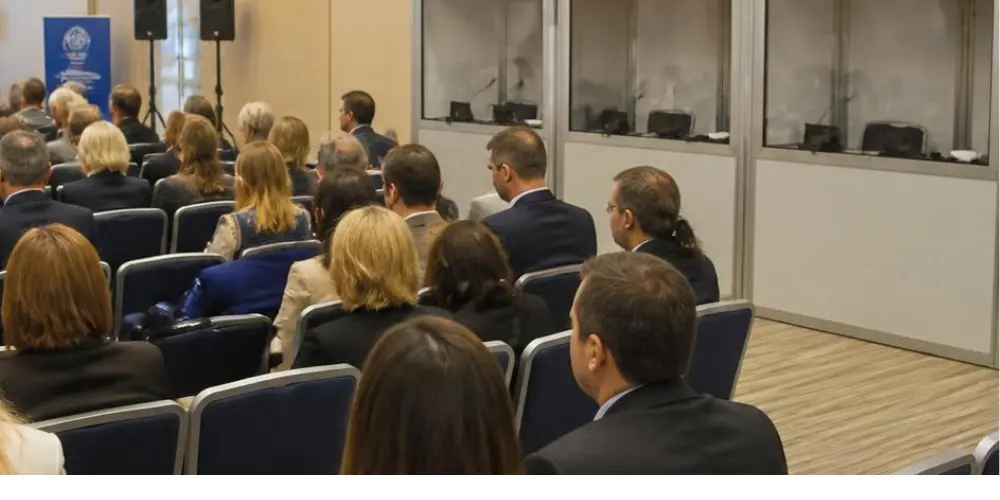
Finding a simultaneous interpreter is hard. Finding one for uncommon language combinations is a challenge. Finding one at short notice is nearly impossible. And then: due to sickness, strikes or traffic they may not make it on time to the event. This is what AI-powered live translation can do for you when human interpretation falls through, and why not all AI systems are equally suited to serve as a backup.
The Interpreter Shortage Is Not an Edge Case
Anyone who has organised a multilingual conference knows that finding simultaneous interpreters, especially for less common language combinations, is not a simple task. These are highly specialised professionals who book up months in advance. For rare language pairs, say Japanese-Finnish or Arabic-Polish, the pool of available, qualified interpreters is genuinely small.
This is not a new problem, but it is getting more acute. Demand for multilingual events keeps growing, driven by globalisation and hybrid formats that make it easier to invite international speakers and audiences. Many event organisers report increasing difficulty securing interpreters, especially for less common language combinations, and in some markets supply has struggled to keep pace with demand. The result is that securing interpretation for these events is a logistical exercise that starts months before the event date and still carries risk.
Rare language combinations are almost always handled through a technique called relay interpretation (or relais): one booth translates from Finnish into English, and a second booth picks up that feed to translate into the target language. Since simultaneous interpreters always work in pairs — rotating every 15 to 30 minutes to manage the cognitive load — a relay setup means you are coordinating not two individuals but two full teams. It is standard professional practice, but it compounds the risk considerably: a single cancellation in either booth can break the chain.
The travel risk has changed shape in recent years. Many simultaneous interpreters now work remotely, from their homes or studios, feeding their translation directly into the event's audio system. This Remote Simultaneous Interpretation (RSI) model eliminates flights and hotel logistics. But it introduces a different kind of fragility: a local internet outage at the interpreter's location, a router failure, or a sudden power cut can kill the feed just as effectively as a missed connection at an airport. The single point of failure has moved from the departure gate to the home broadband router.
When Things Go Wrong: The Real Risk to Your Event
A strike at an airport. A monsoon. An accident. A sudden illness the night before... Or just an interpreter who gets lost in the UNO's corridors. These are not exotic scenarios. They happen, and when they do, the event organiser faces a situation that no amount of planning fully prepares you for: an event starting in a few hours, an audience expecting multilingual access, and no interpreter.
A recent case in Japan illustrates the problem well. An event organiser had already booked human interpreters for a major conference, but was worried about what would happen if something disrupted their travel. He looked into using an AI translation system as a fallback, something to activate only if the interpreters could not make it. When he asked one AI interpretation provider for a quote, he was told that their service required sending people on-site for setup. The cost and complexity of that alone made it impractical as a backup option. He would essentially have been paying the full price of a primary service just to have a safety net he hoped never to use.
This is the hidden problem with the backup use case: the insurance policy cannot cost as much as the thing it insures.
Can AI Interpretation Really Serve as a Backup?
Yes. AI simultaneous interpretation has matured considerably in the past few years. The quality is not identical to a skilled human interpreter working in their area of expertise, but it is professional, real-time, and often sufficient to ensure that a multilingual audience can follow the event rather than sit through it in silence. That is exactly what a backup needs to do.
One practical check is worth making early: not all languages are yet available for AI live interpretation. Nubart TRANSLATE currently covers 33 languages, and the list keeps growing as the underlying technology matures. For the most common conference languages this is rarely an issue, but if your event involves a minority language, it is worth confirming coverage before you rely on it as a contingency.
If you have time to share context documents before the event — agendas, speaker notes, technical materials — the AI will be better calibrated to your specific vocabulary. But that is the difference between good and very good, not between working and not working. In a contingency situation, you activate it and it is immediately operational.
The Onboarding Problem: Why Most AI Tools Are Not Built for This
This is where many products in this space show a significant limitation for the backup use case.
Several of the established players in this space have built their products around a managed services model. They assign a project manager to each event. They send technicians, either on-site or remotely, to set up and monitor the session. They offer onboarding programmes with platform walkthroughs, technical tests, and follow-up calls. For multi-day congresses with complex AV setups, this full-service approach is exactly what many organisers want and need.
But it makes the backup use case very difficult to justify economically.
If booking an AI interpretation system requires scheduling an onboarding session, waiting for a project manager to be assigned, paying a setup fee, and arranging for a remote technician to connect an hour before your event starts, then you cannot realistically use that system as a contingency. You are not buying a backup. You are committing to a second primary service with its own lead time, personnel, and cost.
Some providers add implementation or onboarding fees on top of the base service cost, and others require annual subscriptions as their entry point, which means even accessing the platform as a one-off is not straightforward. None of that is unreasonable for their intended market. But it is incompatible with the idea of a standby system you activate only if you need it.
A Different Approach: Test Today, Use Tonight
Nubart TRANSLATE approaches the problem differently. No hardware. No on-site technician. No project manager assigned to your event. The speaker uses a browser on any device and logs in with their credentials. The audience scans a QR code on their phone. That is the whole setup.
The free trial gives you the real thing, not a demo environment. The QR code and the speaker login you test with are the same ones you use if you go ahead and order. You can print the code ahead of time. There is no reconfiguration, no new session to set up, nothing to reinstall. Practically, it means that the configuration you test is the configuration you will use on the day; there is nothing new to learn or reconfigure.
Pricing is pay-as-you-go, per event day. No annual subscription required. No setup fee. After the 7-day cancellation window, the fee applies regardless of whether the system was activated during the event. This reflects the fact that the service has been configured and reserved for you, and it means you can budget for the backup without any surprises.
In practice, the most resilient setup combines both approaches: human interpreters as the primary channel, with AI interpretation standing by as a fallback for additional language combinations or in case the primary feed fails. That is exactly the scenario the Japanese organiser had in mind: request a trial, test the language pair, place an order, and set it aside. If the interpreters arrive safely, the event runs as planned. If they do not, the backup is ready to activate without involving anyone else.
How to Plan for This Properly
If you are organising an event that depends on human interpreters, especially for rare language combinations or where interpreters need to travel internationally, here is a sensible approach to protecting yourself.
Request the Nubart TRANSLATE trial well before the event. Use the 30 minutes to test the actual language pair you need. Check that the audio setup works in your venue or with your microphone configuration. If the result meets your standard, you will find the ordering button right in the link you receive for the trial. Place an order right away and, if available, share your event materials: agenda, speaker bios, topic summaries. This gives the AI the context it needs to be well prepared. If they are not available yet, you can upload them anytime in your customer area, under assets: our team will get an automatic notification and prepare them for your event in less than 24 hours.
Then set it aside. You probably will not need it. But if you do, the system is already configured, the QR code is already printed or ready to share, and your speakers already know how to log in. Activating it on the day is a matter of minutes.
The interpreter shortage is a real constraint. Travel disruptions are unpredictable. Building a contingency into your event planning is not excessive caution. It is the kind of professionalism that your international audience deserves. In IT and enterprise event management, this kind of planning is usually discussed in terms of redundancy, failover, or business continuity: making sure that a critical service remains available when one component fails. The same logic applies to interpretation.