
Rosa Sala
Revenue share for audio guides: an old model, back for the smartphone era
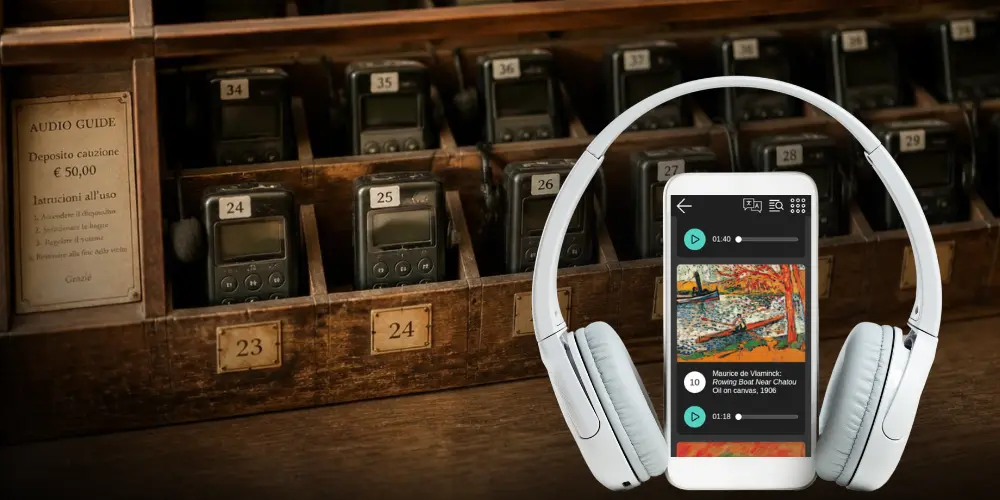
Revenue share used to be one of the most lucrative parts of running an audio guide program, back when museums leased physical devices from a handful of large providers and split the proceeds.
What made that model work was never the device itself. It was controlled access: a rented device could only ever reach one paying visitor at a time.
Smartphones didn't break the business model because visitors stopped wanting guides. They broke it because a URL or an app isn't something you can rent. A QR code or a link can be copied indefinitely, so one paying visitor no longer meant one guide, and audio guides became far easier to distribute and far harder to sell. Nubart GUIDE restores that link digitally: a patented mechanism makes a QR code non-transferable again, with every activation logged and verifiable, without asking visitors to download anything or pay twice. What follows is a look at how revenue share actually worked in the device era, why every attempt to digitize it has struggled, and how controlled digital access makes the old economics viable again.
This article explains the commercial models; our companion article explains the practical mechanics of selling a QR-code audio guide.
The device era: how revenue share worked
Those of us who have been in the audio guide market long enough, like Nubart, still remember the tail end of the golden era, before smartphones, when audio guides were sophisticated and costly dedicated devices and the market was dominated by a handful of multinational providers with real negotiating power. That old model still exists today, but the rise of BYOD (bring-your-own-device) has steadily shrunk it and added new formats to the mix: first native apps, then, around 2015, PWA or web-app audio guides accessed by QR code.
In those years, audio guides were a meaningful income source for both providers and museums, mostly thanks to the traditional revenue share model. After a public tender, the museum would grant a concession, typically for four or five years, to a provider and hand over a few square meters of reception space. The provider produced the content (with museum oversight), installed a counter, stocked it with devices, hired a couple of people, usually students, to hand them out and collect them, and paid the museum a share of the resulting profit. The museum didn't have to manage any of it.
One of the giants of that era, roughly the 1980s through the 2000s, was Antenna International, the company behind the well-known Alcatraz audio guide. It went bankrupt a few years later, one of several device-era giants that couldn't survive the shift to digital. Sharing real figures from a revenue share agreement at a Catalan museum from about ten years ago doesn't give away any secrets at this point:
| Investment by Antenna (content production, devices) | ca. €39,500 |
|---|---|
| Visitor price | €5 |
| Visitors/year | 800,000 |
| Take-up rate | 5% (40,000 activations) |
| Total revenue | €200,000 |
| Museum's share (50%) | €100,000 |
| Antenna's share (50%) | €100,000 |
| Antenna's annual staff cost | ca. €36,000 |
| Antenna's net revenue/year | €64,000 |
| Museum's net revenue/year | €100,000 |
€100,000 a year in exchange for temporarily giving up a few square meters of space looks like an excellent deal for the museum. It was a smaller but still attractive sum for Antenna too, once installation and content costs were amortized over the life of the contract.
Is the audio guide paid extra or included in admission? Two models of revenue share
Antenna's deal is what we and some other vendors sometimes call a voluntary or opt-in arrangement, though the label isn't standardized industry-wide: admission gets a visitor into the building, the guide is a separate purchase, and only a fraction ever buy it, 5% in Antenna's case, in line with the roughly 3% take-up the sector generally reports for paid permanent-collection guides. Procurement documents more often describe this as an optional paid guide.
There's always been a sibling model, sometimes called universal or inclusive, that tenders more commonly describe as included in admission or all-inclusive pricing: the guide's cost gets folded into the ticket price itself, so every visitor receives one whether they use it or not.
The terms "voluntary" or "universal" describe how the guide is sold to visitors; the underlying contract can take different forms.
The two solve different problems. A voluntary deal costs the museum nothing upfront and lets price-sensitive visitors opt out. A universal deal reaches everyone, at the cost of every ticket getting slightly more expensive whether or not the guide gets used. In both models, the economic principle is the same: the revenue generated by the audio guide, whether as a separate purchase or as part of the admission fee, is shared between the museum and the audio guide provider.
The digitization of audio guides
With smartphones, this profitable model became mostly the preserve of large museums still committed to dedicated devices. Some providers still engineer and commission the manufacture of fully dedicated branded devices, often produced in China. Many others simply use Android phones running in kiosk mode, locked to the guide app and housed in rugged, easy-to-clean cases.
Most mid-sized museums, with less negotiating leverage, moved to digital systems instead. Around 2010 everyone thought native apps were the future. But a persistently low adoption rate pushed the 2020s, especially after the pandemic got everyone used to scanning QR codes, toward web-app or PWA guides: nearly all the capability of a native app, opened directly in any browser, no app store required.
Bringing audio guides into the digital world came at a cost, though. Whether native app or PWA, what used to be a source of income turned into a line item of expense.
Can revenue share survive the move to digital?
Attempts to generate revenue from digital audio guides have mostly fallen flat. Native apps can charge for downloads, but it quickly became clear that almost no visitor is willing to pay for an audio guide app before even trying it, so making them free, just to nudge adoption a little higher, became the only realistic option.
QR-based guides face a different problem. A QR code is, by default, just a link, easy to share, and a link with no restriction on who can use it has no commercial value on its own. Some providers have tried porting the in-app payment model common in native apps, particularly gaming apps, over to QR guides: the visitor scans the code, perhaps hears a track or two as a teaser, then hits a paywall to unlock the rest.
Others use a QR code that opens a page where the visitor must enter a numeric access code received at the ticket desk before the guide can be accessed. In theory that code is unique; in practice, many such systems rely on codes that can be reused, guessed, or shared, so they still struggle to create genuinely non-transferable access.
Why digital payment and access codes both create friction
On paper, charging inside the app after the QR scan looks like a natural way to bring the old revenue-share economics into the smartphone era. In practice, it runs against how people actually behave.
In our experience, payment integrates far more easily at a point where the visitor is already making a purchase: the ticket desk, bundled with admission, or online booking, where paying for the visit is already the task at hand and an optional extra fits naturally into that same checkout. A charge introduced after entry, once the visitor has already paid for admission and just wants to start the guide, adds a new decision and a new transaction step at a moment nothing else calls for one. It also tends to mean a second card-payment step routed through its own processor, so the transaction that didn't need to be split gets split anyway.
The access-code model avoids that payment friction, but it creates a different kind of friction. Visitors have to type a code on their own phone before they can start the guide, and that turns out to be a surprisingly fragile step. Mistyping a long code, losing the receipt it was printed on, or simply struggling with a smartphone keyboard creates immediate frustration and often requires staff intervention. Older visitors and less tech-savvy users are affected disproportionately, and the process is significantly less accessible than simply scanning a QR code and listening.
How Nubart brought the old model back
Nubart's answer wasn't to bolt a paywall onto a generic link. It was to change what a QR code can be.
The LWAC patent binds a QR code to whoever activates it first. It stays usable by that person indefinitely, with no time limit, no app, no login and no personal registration, but it becomes worthless if forwarded to anyone else. For physical cards, that binding happens at the card; for codes delivered through online ticketing, it happens at the link. That single property turns a QR code from a shareable freebie into something with real commercial value.
Patented in the EU, Spain and the USA — granted
The physical version does something a link alone can’t: it gives visitors something to hold. A printed, branded card feels like a keepsake rather than a fee for a phone link, which is one reason it has become Nubart’s most common format. More importantly, the card remains valid for its holder indefinitely. That changes the purchase decision in a subtle but important way. Visitors no longer have to worry about “getting their money’s worth” during a two-hour visit. They can listen selectively in the museum and continue exploring the content on the way home, days later, or even weeks later. In our experience, simply knowing that the guide is theirs to keep increases people’s willingness to pay for it, even if many of them never return to the content afterward. In effect, the card changes the guide from a time-limited consumable service into a durable purchase, and that reduces one of the biggest psychological barriers that traditional rented audio guides have always faced.
The printed format opens a funding channel a digital-only version can’t, too: some museums add a sponsor’s logo to the card as part of their own funding arrangement, something considerably harder to pull off on a native app or a rented device. It also has a small but important accessibility advantage. The QR code on Nubart’s cards is printed with a subtle tactile relief, allowing visually impaired visitors to locate it with their fingertips and scan it discreetly without needing assistance.
The accounting problem revenue share never solved
One weakness of traditional revenue-share concessions involving audio guide devices was auditability. Museums rarely had an independent way to verify how many devices were actually rented, so the model depended heavily on the operator’s accounting.
When the accounting isn't crystal clear, a dispute over the numbers can escalate a long way, even when nobody involved acted in bad faith. The Alhambra's audio-guide concession is the case that made this most visible: a dispute over the contract's accounting led to a criminal investigation and trial that took about eight years to reach a first verdict. Whatever the final outcome of this case, it illustrates how expensive uncertainty can become. A transparent activation record would have settled the numbers long before lawyers became involved.
Nubart solves the accounting problem differently. Every activation is recorded automatically and visible to the museum in real time, which makes voluntary revenue-share agreements straightforward to verify because payment is tied directly to activation.
The more complicated situation is the universal model, where cards are handed out to all visitors and some of them may never be activated. In Nubart’s universal revenue-share contracts, the museum and Nubart use a documented reconciliation process. Cards are issued in numbered batches, invoices identify the specific card numbers involved, and both parties have a contractual procedure for challenging any discrepancy. The aim is that both the museum and Nubart can verify the accounting independently, without either side having to rely solely on the other’s records.
LWAC controls who can access the guide; the activation record controls whether anyone can dispute how many people did.
Percentage revenue share versus per-activation revenue share
Not all revenue-share agreements work the same way. In public museums, the visitor price is usually set or approved by the museum itself, so the real difference between revenue-share models is less about who chooses the price than about how the provider is remunerated. Traditionally, the provider receives a percentage of whatever the visitor pays for the audio guide. If the museum charges €5 and the agreed split is 50%, the provider receives €2.50.
Nubart’s revenue-share model is structured differently. Instead of taking a percentage of the visitor price, the museum and Nubart agree in advance on a fixed remuneration per card. In voluntary projects, remuneration is tied to activations; in universal projects, the contract distinguishes between distributed cards and activated cards, with different agreed amounts for each. The museum keeps control of the visitor price and of the margin it builds into that price.
In practice, both models care about take-up. No audio-guide provider benefits from a price that is so high that hardly anyone rents or buys the guide. The difference is that, in a percentage-based model, the provider’s remuneration is directly linked to the museum’s selling price, whereas in Nubart’s model it is linked to the agreed economics of each distributed and activated card.
That means we spend a great deal of time helping museums find the right visitor price. Across Nubart installations, we have found that take-up is usually strongest between €1 and €3 and falls noticeably at €5. A museum selling many cards at €3 can often earn more than one selling far fewer at €5. Because our remuneration depends on cards actually reaching and being used by visitors, we have a direct interest in maximising total guide revenue rather than simply negotiating the highest possible visitor price.
| Model | Visitor pays | Provider is paid | If nobody uses it | How provider remuneration is calculated |
|---|---|---|---|---|
| Flat subscription | optional | fixed fee | yes | none |
| Percentage revenue share | yes | % of visitor revenue | no | percentage of the museum-approved visitor price |
| Per-activation (Nubart) | optional or bundled | fixed amount per activation | no | agreed amount per distributed and activated card |
See it for your museum — request a quote, or order a free sample card to try the experience yourself.
We hope you found this article useful. Subscribe to our newsletter so you don't miss any of our posts.
You may also be interested in
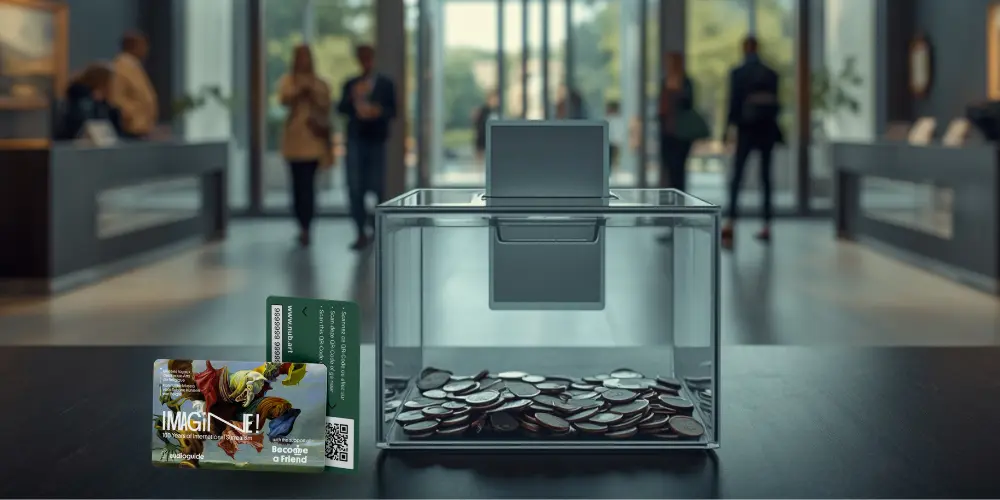
How museums monetise a QR-code audio guide
A QR code can be shared endlessly, so a public link cannot be sold. How Nubart's patented LWAC makes a card non-transferable — with real take-up data and a break-even calculator.
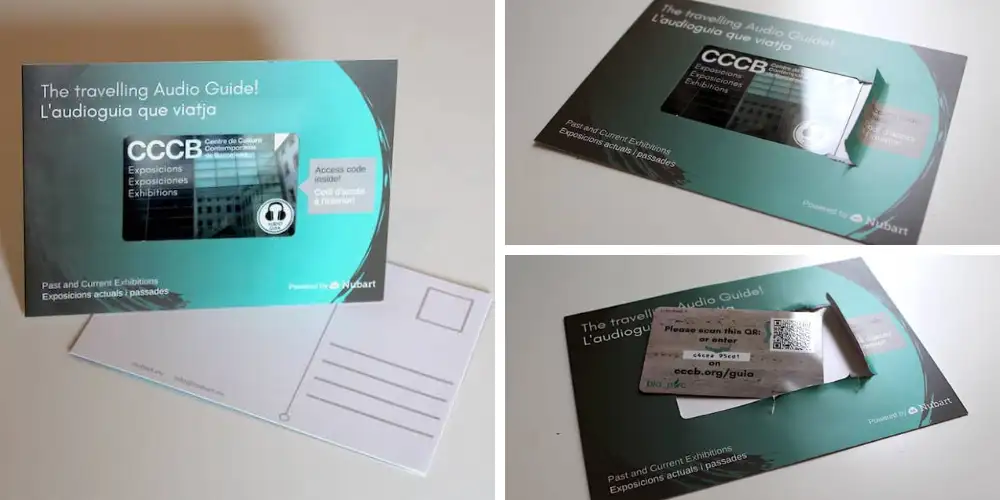
Turn your audio tour into postcards for the museum shop
A non-transferable QR card doubles as a souvenir. How museums sell the audio guide as a postcard visitors take home.